

Infection prevention and control involves a wide range of daily responsibilities, from assessing risks and maintaining clean environments to monitoring infections and communicating information. NHS guidance brings these activities together as part of a consistent approach to safer care.
Infection control boards give teams a shared place to organise relevant information. Their purpose can vary considerably: one ward may need a dedicated display for approved guidance, while a specialist infection prevention team needs a structured overview of surveillance information.

At Visual Systems Healthcare, our past NHS board designs illustrate how different layouts can support these different requirements.
Keeping infection control information together
A dedicated information board provides a recognisable location for infection prevention updates and documents.
Our Coral Ward design for East London NHS Foundation Trust features nine A4 document pockets behind a clear acrylic door. This creates an organised display where individual documents can be replaced as information changes.
A layout of this kind could accommodate locally approved guidance, audit summaries, contact information and current priorities. The contents can evolve while the board retains a consistent structure.
The practical consideration is ownership: deciding who maintains the display, checks document versions and removes information that is no longer relevant.
Giving surveillance information a clear structure
Specialist teams may need a board that supports the regular review of infection surveillance information.
Our design for Guy’s and St Thomas’ includes a monthly alert-organism surveillance grid, with fields for patient initials, hospital number, ward or area, relevant dates and comments. Separate summary spaces cover MRSA, MSSA, C. difficile, E. coli, Klebsiella and Pseudomonas.
This illustrates how a bespoke layout can bring detailed entries and monthly totals into one organised view, providing a reference for team discussions and updates.
The fields should reflect the organisation’s current surveillance definitions and working practices. Boards containing patient information also require appropriate placement and access arrangements.

Bringing monthly and quarterly information into view
Some infection prevention teams need to organise information across a longer reporting period.
Our planner design for the Robert Jones and Agnes Hunt infection control team combines a January-to-December overview, quarterly sections and a structured case-recording area. Magnetic labels provide a way to distinguish selected infection and resistance categories.
The layout brings several timescales together. Teams can use a similar structure to organise entries throughout the year and refer to them during periodic reviews.
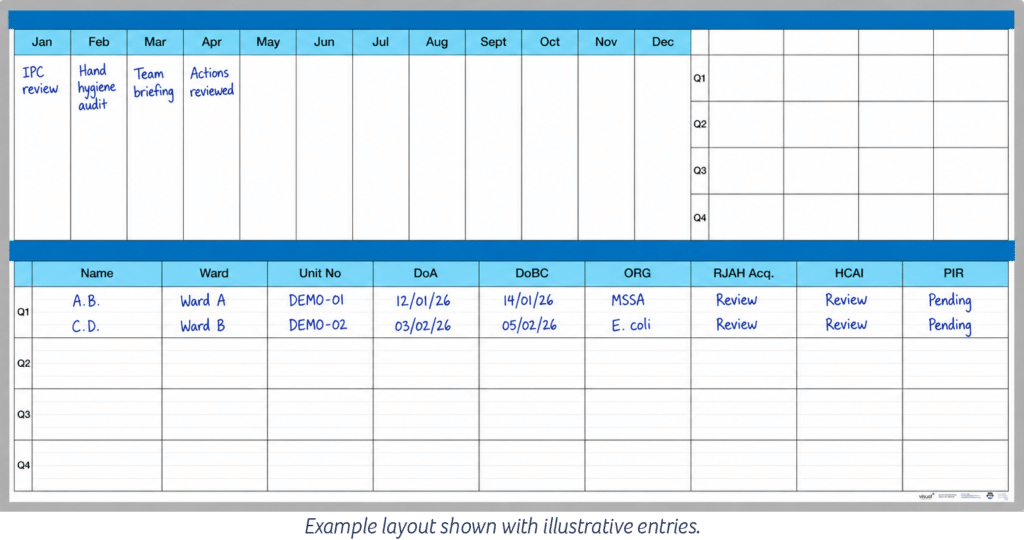
This demonstrates the value of designing around a team’s reporting process: the arrangement of months, quarters and case details can follow how information is collected and discussed.
Supporting coordination across isolation areas
Boards can also provide a shared operational overview across several clinical areas.
Our Watford General isolation-board design uses repeated ward sections with columns for bed number, patient name, swab date, swab result, oxygen therapy and plan.
Repeating the same headings across each area creates a consistent format for recording and reviewing information. A current design could be adapted to the fields a clinical team needs for its own coordination and handover processes.
The information must be kept current, with clear responsibility for updates. The board’s role should also be defined alongside the organisation’s clinical records and other systems.

Example bespoke isolation-area board with repeated sections for recording bed-level swab, oxygen therapy and planning information across four clinical areas.
Providing space for changing priorities
A flexible layout can be useful when the information being displayed changes frequently.
Our Chase Farm Hospital design for Royal Free London features a clearly titled “Infection prevention and control” area with an open central space.
This provides scope for locally selected content without committing the entire display to fixed categories. A similar approach could accommodate changing priorities, campaign information or temporary updates.
The choice between a structured grid, document pockets and an open display area should follow the intended use and the people who need to read it.
Designing an infection control board around your team
An effective brief starts with a few practical questions:
- Who will use the board, and where will it be positioned?
- What information needs to be visible?
- Which sections should be permanently printed?
- Where would document pockets or magnetic elements be useful?
- Who will update the information, and how often?
- Which cleaning processes must the finished product accommodate?
These decisions help create a board with a clear purpose, a manageable layout and an agreed place in everyday work.
Visual Systems Healthcare designs and manufactures bespoke infection control boards for healthcare environments. From information displays to surveillance grids and team planners, we can develop a layout around your requirements.


Further guidance and sources:
National Infection Prevention and Control Manual for England – https://www.england.nhs.uk/infection-prevention-and-control/nipcm-for-england/
Standard Infection Control Precautions – https://www.england.nhs.uk/infection-prevention-and-control/nipcm-for-england/chapter-1-standard-infection-control-precautions-sicps/
Healthcare-associated infections: guidance, data and analysis – https://www.gov.uk/government/collections/healthcare-associated-infections-hcai-guidance-data-and-analysis
Health and Social Care Act 2008: Code of Practice on the prevention and control of infections – https://www.gov.uk/government/publications/the-health-and-social-care-act-2008-code-of-practice-on-the-prevention-and-control-of-infections-and-related-guidance
National Standards of Healthcare Cleanliness 2025 – https://www.england.nhs.uk/publication/national-standards-of-healthcare-cleanliness/